
Vietnam and Indonesia often end up in the same bucket in Southeast Asia market reviews. Both are mobile-first markets that switched from cash to QR payments within a few years, and both ban online gambling. The payment systems underneath, and the way regulators police them, are quite different, and that changes how iGaming payments and the wider digital economy work in each country.
This article compares the two on regulation, payment rails, consumer habits and risk for payment providers. Each country also has its own articles in this series, linked at the end.
Vietnam vs Indonesia at a glance
Market size and structure
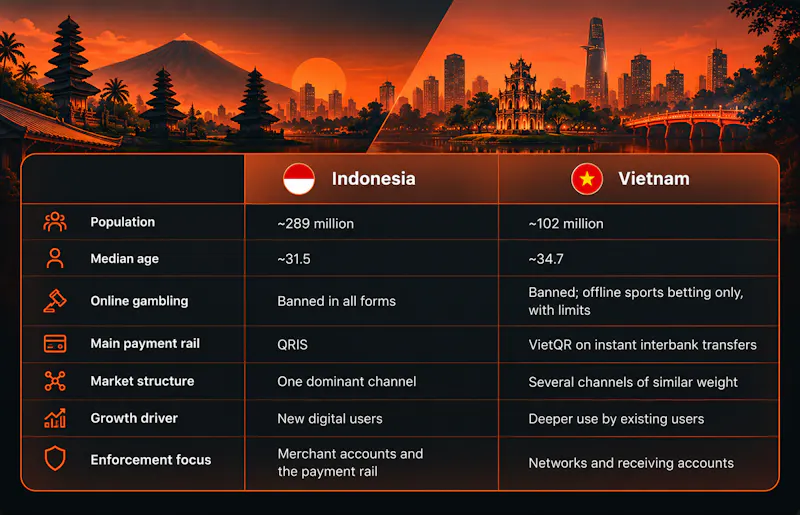
Indonesia has close to three times as many people as Vietnam, and its median age is about three years lower. Much of its digital payments growth still comes from new users, people whose first bank account and first cashless payment both happened on a phone. Transaction counts rise quickly while the average ticket stays small, and most new merchants are warungs and other micro-businesses with a printed QRIS sticker at the till.
Most Vietnamese adults already bank on their phones, so the market has less room to add users. Growth comes from moving the remaining cash spending online and from getting shops off personal transfer accounts and onto merchant accounts. The user base grows slowly, but each user pays through more channels.
For a payment provider entering Indonesia, most of the effort goes into onboarding and handling volume. Vietnam is harder on the technical side, with routing across several rails and more integrations to maintain. The demand side of each market is covered in Indonesia payment trends 2026 and Vietnam payment trends 2026.
Online gambling regulation in Vietnam and Indonesia
On paper the rules look much the same, since neither country licenses online gambling. Enforcement works differently, though.
Indonesian authorities build most of their cases from payment data. PPATK, the financial intelligence unit, tracks deposit flows and publishes figures on them. The digital ministry has blocked tens of thousands of bank and e-wallet accounts tied to illegal sites, and Bank Indonesia has tested machine learning models that flag syndicate accounts. A PSP in Indonesia is judged mainly on the merchants and sub-merchants it signs up and on what flows through them.
In Vietnam, police cases usually begin with the betting network itself and only then follow the money into bank accounts and wallets. Since 2024 that has become easier. Transfers above VND10 million need biometric confirmation, and accounts whose holder data hasn’t been matched to a chip ID can no longer pay online. The question for a PSP here is less about the merchant category and more about who actually controls the receiving accounts, and whether the payment flow fits the business on file.
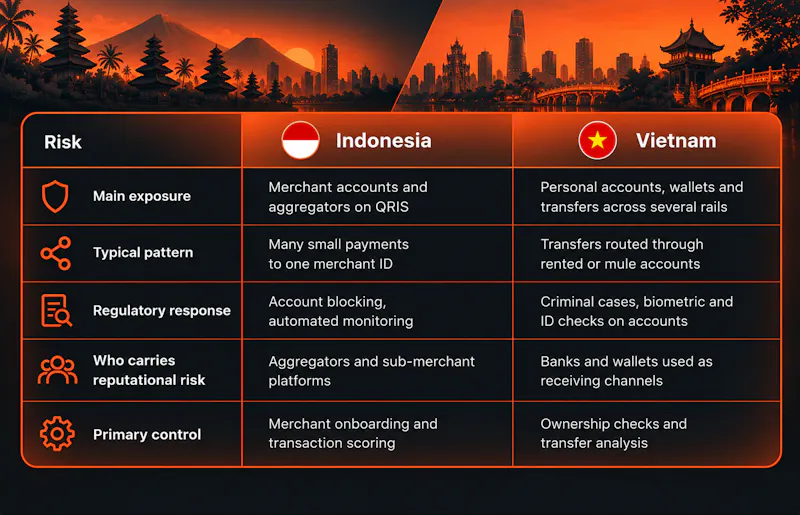
For compliance teams, that shifts the weight. Merchant risk scoring and transaction monitoring do most of the work in Indonesia, while in Vietnam ownership checks and transfer pattern analysis matter just as much. The legal background is in iGaming payments in Indonesia and iGaming payments in Vietnam.
QRIS vs VietQR
To a customer the two look identical: a code on the counter or on screen, scanned with a banking or wallet app. The difference is in what happens after the scan.
QRIS is a merchant payment standard set by Bank Indonesia. Every QRIS merchant has a national merchant ID, signs up through a licensed acquirer and is settled as a business. One code works with any bank app or e-wallet, so banks and wallets compete on the same rail instead of running their own, which is how Indonesia ended up with one dominant payment method.
VietQR began as a shortcut for filling in bank transfer details. The scan starts an instant interbank transfer through NAPAS, and the money lands in whatever account the code points to, often the shop owner’s personal one. That works for paying a street vendor, but the payment carries no merchant data. NAPAS has started rolling out VietQRPay to close the gap, with codes tied to registered business accounts that pass merchant and order details along with each payment.
This also decides where monitoring starts. On QRIS the obvious control point is the merchant and the acquirer or aggregator behind it. A VietQR payment has to be judged by the receiving account and the pattern of transfers coming into it. QRIS transaction patterns are covered in QRIS and online gambling in Indonesia, and the Vietnamese rails in Vietnam payment methods: VietQR, bank transfers and e-wallets.
E-wallets and instant payments
Indonesia’s big e-wallets, GoPay, OVO, DANA and ShopeePay, all accept QRIS and connect to BI-FAST, the national instant transfer system. For the payer, a wallet is often just one more app to scan a QRIS code with, so for a merchant being on the rail matters more than which wallets it lists at checkout.
Vietnamese wallets are more self-contained. MoMo and ZaloPay run their own ecosystems for bills, top-ups and online shopping, and plenty of people keep a balance in a wallet alongside their bank app. Instant bank transfers still carry most of the volume, but the wallets hold enough share that leaving them out costs conversions.
In practice, one solid QRIS connection covers most of Indonesia for a licensed merchant. Vietnam usually takes three integrations: dynamic VietQR, direct bank transfers and at least one of the large wallets.
Consumer behavior
Indonesian users are younger and newer to digital finance. They pay often, in small amounts, and like the flow to be the same every time. Once someone trusts one way of paying, usually QRIS from a familiar app, they rarely look for another.
In Vietnam people have been paying digitally for longer and are pickier about it. Someone might scan a code at a café and pay a bill from a wallet an hour later, and they notice quickly when a payment is slow or the recipient name on the confirmation screen doesn’t match the shop. Banks now warn customers before a transfer to an account flagged for fraud, which has made people more careful.
A short, predictable checkout works best in Indonesia. In Vietnam it is worth offering a choice of methods and showing clearly who is being paid.
Market risks compared
In both countries the underlying risk is illegal operators using legitimate payment infrastructure to collect money. The table shows how that plays out in each market.
Cross-border providers carry an extra layer of risk in both markets. Local banks and acquiring partners judge a provider by its client base, and one badly vetted merchant can be enough to lose a corridor.
Choosing a Southeast Asia payment gateway
When building or choosing a payment gateway for Southeast Asia, many teams start from a single regional playbook and adapt it country by country. For these two markets that approach tends to break early. Indonesia rewards deep integration with one rail and tight control over merchants and sub-merchants, whereas Vietnam requires covering more methods and knowing who sits behind each receiving account. Most teams end up building separate risk models and monitoring rules for each country.
Gambling is banned in both, so compliance has to be part of the product from the first day. A provider that loses the trust of local banks and regulators loses access to the market.
FAQ
Is online gambling legal in Vietnam or Indonesia?
No. Indonesia bans gambling in any form. Vietnam bans online gambling and allows sports betting only offline, with daily limits.
What is the difference between QRIS and VietQR?
QRIS is a merchant payment standard: the money goes to a registered business through an acquirer. VietQR starts an instant bank transfer to any account, and a merchant version called VietQRPay is now being added on top.
Which country has the bigger digital payments market?
Indonesia has more users and far more transactions. Vietnam’s market is smaller, but its users are more experienced and spread their payments across more channels.
What payment methods are used in Vietnam and Indonesia?
In Indonesia, mostly QRIS, mobile banking and e-wallets that accept QRIS. In Vietnam, VietQR, instant bank transfers, MoMo, ZaloPay and domestic debit cards.
What are the main payment risks in these markets?
In Indonesia, merchant accounts on QRIS being used to collect illegal deposits. In Vietnam, personal and mule accounts receiving transfers on behalf of illegal operators.
Read the full series
Indonesia
- iGaming Payments in Indonesia: Regulation, Payment Methods and Compliance Risks in 2026
- QRIS and Online Gambling in Indonesia: Transaction Patterns, Monitoring and What PSPs Need to Know
- Indonesia Payment Trends 2026: How Mobile, QRIS and Instant Payments Are Changing Consumer Behavior
Vietnam