
Vietnam is older than most of its neighbors. Its median age is 34.7 years in 2026, against 31.5 in Indonesia, and UN projections put it at 41.1 by 2050. Yet digital payments in Vietnam keep growing fast: in the first half of 2026, cashless transactions rose 34.56% year on year, according to the State Bank of Vietnam (SBV).
An aging population has not slowed the switch. Most pensioners now keep their money in bank accounts, and many market stalls accept QR payments. Official data on Vietnam's main payment trends for 2026 show how consumer behavior is changing.
Vietnam digital payments in 2026: what the SBV data shows
The base was already high before 2026. Between 2021 and 2025, cashless transactions grew by about 59% a year on average, mobile payments rose more than eightfold, and QR payments nearly twentyfold. In 2025, cashless payments exceeded 28 times GDP, with nearly 85 million transactions a day.
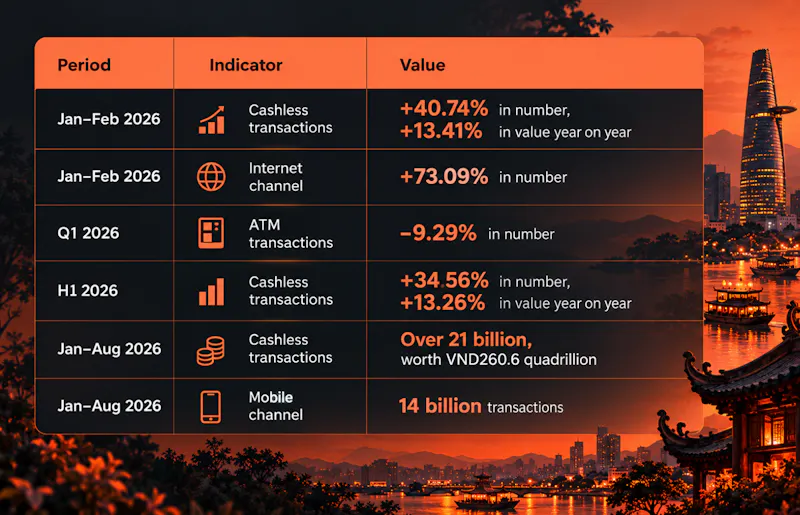
Mobile payment in Vietnam is now the main channel, with about two in three cashless transactions made on a phone. The number of payments is growing more than twice as fast as their value, so the average payment is getting smaller. That suggests more small, everyday purchases are being paid digitally.
The SBV wants Vietnam to move further toward a cashless society. Its 2026–2030 financial inclusion strategy targets cashless payments worth 30 times GDP and bank accounts for 95% of people aged 15 and over by 2030, up from about 89% now.
Age is not a barrier: Vietnam’s aging population and who pays digitally
Vietnam’s population age profile is shifting fast. About 9.5% of Vietnamese are 65 or older, and the country is on track to become an aged society, with 14% of people over 65, around 2036. So far, that has not slowed digital adoption.
Pensions are the clearest example. In the October 2026 payment cycle, Vietnam Social Security paid monthly benefits to more than 3.56 million people, and nearly 96% of them received the money without cash. In June 2026, the share was about 90%. Banks and local officials helped reach this level by opening accounts at payout points and visiting older people at home.
People still take cash mainly because of location, not age. In Nghe An province, 156,908 of 166,055 pensioners received their money through an account in August 2026. In Con Cuong, a mountainous district of the same province, only 1,244 of 2,285 did.
Researchers at RMIT University Vietnam found that confidence is the main obstacle for older people. Older adults who are open to new things and draw on their life experience are far more willing to pay digitally, and the team is extending the study to Vietnam.
How everyday spending has changed
Small shops show the shift most clearly. In Ho Chi Minh City’s Tan Thoi Hiep ward, a shop owner who switched to QR after help from bank staff and ward officials now takes about 90% of payments by scan. Some wards ask every household to have at least one member with a bank account, and officials walk older residents through the apps.
Cash withdrawals keep falling. ATM withdrawals on the NAPAS network dropped 29% in 2025, and ATM transactions fell another 9.29% in the first quarter of 2026.
Public services and transport have moved too. NAPAS handled more than 6.9 million payments for online public services in 2025, and HCMC’s Metro Line 1 and city buses accept NAPAS cards and Apple Pay. Visitors also pay digitally: in the first nine months of 2026, QR payments by tourists from Thailand, Laos and Cambodia in Vietnam grew elevenfold year on year.
Trust and security: how people react to fraud warnings
The SBV describes trust as the invisible infrastructure of digital payments. Its SIMO system flags transfers to accounts linked to fraud. By 26 August 2026, it had warned more than 5.1 million customers, and nearly 1.7 million of them paused or canceled payments worth over VND5.7 trillion. About one in three people who got a warning stopped the payment.
Identity checks are now routine. By August 2026, banks had matched 174.5 million personal customer records with biometric data from chip ID cards or the VNeID app. According to the SBV, that covers every account used for digital transactions.
Vietnam vs Indonesia: an older market that pays digitally
Indonesia has a younger population than Vietnam. Vietnam reached Indonesia’s current median age around 2020, and its cashless transactions are still growing by about a third a year.
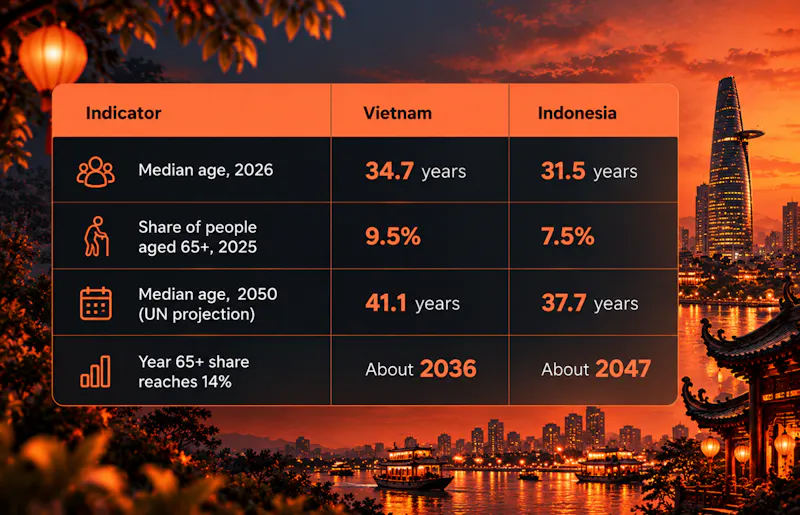
For payment companies working in both countries, Vietnam’s data suggests that access to a bank account and trust in the app matter more than age.
What Vietnam payment trends mean for businesses
Because the average payment keeps shrinking, checkout and settlement need to handle large volumes of low-value transactions at low cost.
Older customers already pay digitally, and they look for familiar steps. Clear merchant names on QR codes and receipts, and a flow that resembles the banking app where their pension arrives, help them pay without assistance. In mountainous and rural districts, cash and cash on delivery are still part of the mix, so a payment flow designed only for Hanoi or Ho Chi Minh City will miss part of the market.
With one in three warned customers stopping a payment, a merchant whose account triggers a SIMO warning is likely to lose the sale. Consistent, verified account details help avoid that.
FAQ: Vietnam payment trends
How fast are digital payments growing in Vietnam?
In the first half of 2026, cashless transactions rose 34.56% in number and 13.26% in value year on year, according to the SBV. Between January and August, Vietnamese made more than 21 billion cashless payments.
Do older people in Vietnam use digital payments?
Yes. In October 2026, nearly 96% of the 3.56 million people receiving monthly social insurance benefits, most of them pensioners, were paid without cash.
What is the median age in Vietnam?
34.7 years in 2026, according to UN data, compared with 31.5 in Indonesia. It is projected to reach 41.1 by 2050.
Cash or card in Vietnam: what do people use more?
Cashless payment in Vietnam is now the everyday choice for most people. About 89% of people aged 15 and over have a bank account, ATM transactions are falling, and the value of cashless payments exceeded 28 times GDP in 2025. Cash is still common in rural and mountainous areas.
What are the main Vietnam payment trends in 2026?
Payments are moving to phones and getting smaller, and pensions have brought older people into the banking system. People have also learned to stop a transfer when their bank warns them about fraud.