
Between registration and the first bet, a new player passes a cashier, a card form, a one-time code from the bank and an approval decision. You paid for that traffic before any of it happened, so every exit is acquisition spend with nothing to show for it. This article looks at first-deposit conversion from the payment side, where you can win back some of the loss without touching your casino or sportsbook product.
It is the first of four pieces that follow a player’s money from deposit to withdrawal.
Six steps stand between a sign-up and a credited deposit
Part of the gap between registrations and first deposits sits in payments, even when it gets reported as traffic quality. On a phone, a first card deposit goes through six steps, and your iGaming deposit conversion is the product of the share of players who survive each one.
- Registration: the form, often an email or SMS code, and any identity checks your license demands before a deposit.
- The cashier, where the player picks an amount and a method. If the usual local method is missing, some players end the session here.
- Card details, or a redirect to a wallet or bank page.
- Authentication. 3-D Secure sends a one-time code or an approval request to the bank’s app, so the player leaves your page and has to find the way back. Timeouts and wrong codes end deposits here.
- Authorization, where the issuing bank says yes or no.
- Crediting. Some methods confirm later, and a “pending” screen with no explanation sends players to support or to another site.
Steps one to four are interface work that your product team owns. Step five works differently: the player has done everything you asked, and a bank you have no relationship with makes the decision. At that step, your only lever is the route the payment takes to the bank.
Why a bank says no to a gambling deposit
Gambling transactions carry merchant category code (MCC) 7995, and issuers treat it as high-risk payment processing. Some decline it by policy, often on credit cards, and others follow local rules that restrict gambling payments. A cardholder may also have switched on a gambling block in the banking app. In each of these cases a casino deposit is declined whatever the balance says, and the player sees only “declined.”
Location matters too. The acquirer is the bank or provider that processes your card payments. When it sits in a different country from the card’s issuer, approval tends to be lower, and a local acquirer often gets the same card through.
Fraud scoring works on top of that. A first deposit is usually a first payment to an unfamiliar merchant, which the model watches for, and an unusual amount or an unfamiliar device raises the score.
The rest is settings and plumbing: online payments switched off on the card, a daily limit, insufficient funds, a failed 3-D Secure challenge, a timeout at the issuer. The last two end the deposit just as surely, though no issuer made a decision.
Logs rarely say why. iGaming payment declines often return code 05, “do not honor,” which tells you the issuer refused but says nothing about why. Grouping by acquirer and by BIN, the first six to eight digits of the card number that identify the issuing bank and its country, gets you further. A cluster of 05s from one issuer on one route says more than the code does.
The payment decline rate also shifts by market, issuer policy, and local rules. We covered two of them: decline rates in Bangladesh and Argentina.
Smart payment routing and cascading win back the declines that aren’t final
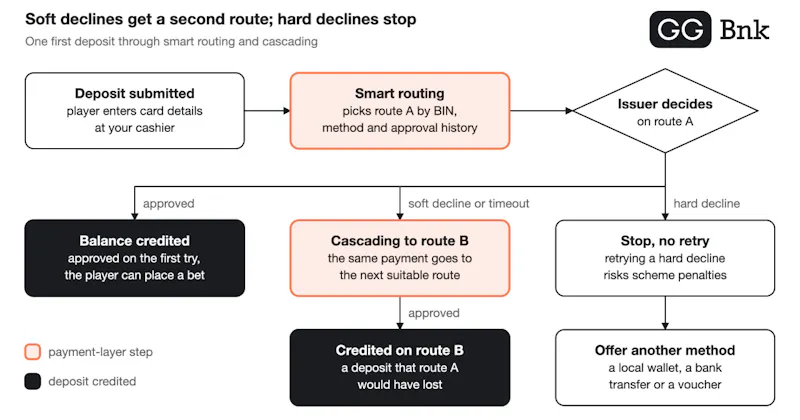
Sort the declines first, because the fix depends on the type. A soft decline is temporary or tied to the route: the issuer was unreachable (code 91), the request timed out, a risk rule fired on one acquirer. The same payment can succeed on another attempt or route. A hard decline is final for the card, such as a lost or stolen card (codes 41 and 43) or an invalid number (code 14). A third group no route can fix. When the issuer or the cardholder blocks gambling, every route gets the same answer, so the remedy is another payment method, such as a local wallet or bank transfer. Our article on the casino payment methods players expect covers that case.
Payment orchestration for iGaming puts several routes behind one integration and adds rules for choosing between them. With smart routing, payments are assigned to a route before the first attempt, based on the card’s BIN, method, currency, amount and each route’s approval history. Sending local cards to a local acquirer is the common rule.
Payment cascading works after a failure. On a soft decline or a technical error the payment moves to the next suitable route, and the player doesn’t fill in the form again, although they may have to pass 3-D Secure a second time.
Cascading goes wrong without discipline. Retry only soft declines and technical errors, cap the attempts per deposit and stop at the first hard decline. Card schemes penalize excessive retries, and a stolen card pushed through three routes invites fraud flags.
How GG|Pay handles it
GG|Pay combines smart routing and cascading behind a single API integration. The same integration covers 15+ countries and 20+ local payment methods, and adding a new market or method doesn't require a new integration. When a local payment system fails, operators on GG|Bnk keep accepting deposits.
Hard declines and gambling blocks stay declined on any route, so routing and cascading can only recover the soft declines and technical errors in your logs.
One-click registration and top-up remove steps before the payment form
Every screen before the card form costs you players. Some of those screens come with your license, and identity or age checks required before a first deposit stay. Others are habits, such as asking for the same data twice or sending the player to a separate wallet sign-up.
Registration and top-up in GG|Wallet take one click each. More of the players you paid for then reach authorization, where routing and cascading can work.
Check what declines cost your first deposit conversion, then connect GG|Pay
Take the last 30 days of first-deposit attempts from your payment logs and count approvals per player as well as per attempt. A player who fails three times and leaves is three declines and one lost deposit. Then split the declines by reason code, BIN or issuer country, method and route. Soft declines and technical errors are the pool you can recover. With those numbers, connect GG|Pay through a single API integration.
FAQ
What is the difference between a soft and a hard decline?
A soft decline is temporary or route-specific, so the same payment can pass later or elsewhere. Issuer timeouts and some risk declines are typical. A hard decline is final for that card, such as a stolen card or a closed account. Only soft declines are worth retrying.
Why is a casino deposit declined when the card has funds?
The balance is one input among several. The issuer also weighs the merchant category (gambling is MCC 7995), local rules, cross-border processing and its own fraud score. Some issuers block gambling on credit cards or on every card, and cardholders can block it themselves.
What is the difference between smart routing and cascading?
Smart routing chooses the route before the first attempt, using the BIN, the method, the amount and each route’s approval history. Cascading acts after a failure and sends the payment to the next suitable route.
Can payment cascading backfire?
It can, if it retries declines that should end at the first attempt. Retrying a stolen card across several routes raises fraud flags, and card schemes penalize excessive retries. Restrict cascading to soft declines and technical errors, and cap the attempts per deposit.
How do I measure first deposit conversion?
Divide credited first deposits by registrations, then split the failures by reason code, BIN, method and route. Compare against your own history: the approval rate in iGaming depends on market, method and traffic mix, so an outside benchmark tells you little.
Does a payment gateway with smart routing need product changes?
Not to your casino or sportsbook. Routing and cascading sit in the payment layer between your cashier and the acquirers. With GG|Pay, it's a single API integration.